The difference between a dental assistant and a certified dental assistant comes down to one thing: proof. Certification tells employers that your skills have been independently verified — that you didn’t just complete a program, but that you passed a standardized exam confirming you can actually do the job.
If you’re evaluating dental assistant programs in College Station, understanding what certification means, why it matters, and how to earn it will help you choose a program that sets you up for the strongest possible start.
What is RDA certification?
The Registered Dental Assistant (RDA) is one of the most widely recognized credentials in dental assisting. Requirements vary by state, but the core idea is the same: you demonstrate competency in clinical dental assisting through an exam administered by a state dental board or national certifying organization.
The certification process typically involves:
- Completing an approved dental assistant training program — this establishes your eligibility to sit for the exam
- Passing a written knowledge exam — covering dental anatomy, radiography, infection control, materials, chairside procedures, and regulations
- Passing a clinical skills assessment — in some states, a practical exam demonstrating hands-on competency
- Meeting state-specific requirements — which may include CPR certification, background checks, or additional coursework
Once certified, you can use the RDA designation — a credential that carries weight with every employer in the field.
Why certification matters for your career
Employers prefer it — and increasingly require it
Hiring managers see certification as risk reduction. When they’re deciding between two candidates, the one with an RDA has proven their skills through a third-party exam. That verification matters, especially for entry-level hires who haven’t built a track record yet.
It affects your pay
Certified dental assistants consistently earn more than non-certified peers:
- Certified RDAs: approximately $46,000–$52,000/year nationally (BLS, Indeed, Glassdoor — 2026 data)
- Non-certified DAs: approximately $38,000–$44,000/year
- Typical premium: $1–$3/hour more, which translates to $2,000–$6,000+ annually
Over a five-year career, that premium adds up to $10,000–$30,000 in additional income.
It speeds up the hiring process
Certified candidates spend less time in interviews proving they can do the job. The credential does that for them. Employers can move faster to make offers, and certified candidates often start working sooner after graduation.
It gives you mobility
RDA certification is recognized across state lines (though specific requirements may vary). If you relocate, your credential follows you — you don’t have to start over.
It opens advancement opportunities
Certification signals commitment and competence. It positions you for lead dental assistant roles, specialty practice positions (oral surgery, periodontics, orthodontics), and office management opportunities as your career develops.
What a quality certified dental assistant program includes
Not every program prepares you equally for certification. Here’s what separates programs that produce certified, employable graduates from those that don’t:
Comprehensive clinical curriculum
The RDA exam tests real skills. Your training should cover:
- Chairside assisting and four-handed dentistry
- Dental radiography — technique, safety, and image evaluation
- Infection control and sterilization procedures
- Dental materials — impressions, cements, composites, temporaries
- Patient communication, intake, and aftercare
- Dental anatomy, charting, and terminology
Training in real dental offices
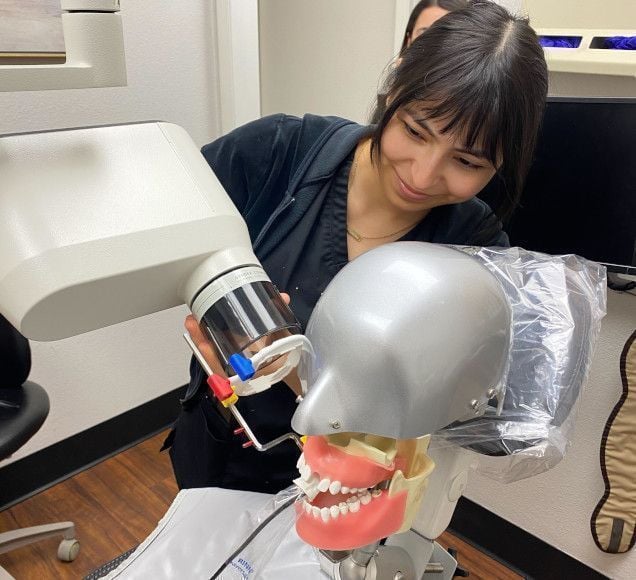
Practicing on mannequins in a classroom is better than nothing, but practicing in an actual dental office is better than everything. Working with real equipment, real workflows, and real patients under supervision builds the kind of confidence that shows in an interview — and on the job.
Integrated exam preparation
The best programs don’t save exam prep for the last week. They weave certification content into every module so that by the time you graduate, you’ve been preparing for months. Practice exams, content review, and test-taking strategies should all be part of the curriculum.
Career readiness support
Certification gets you the credential. Career support gets you the job:
- Resume and cover letter assistance tailored to dental assisting positions
- Interview preparation and mock interviews — knowing how to talk about your skills confidently
- Job search guidance — where to look, how to apply, and what to expect from the process
- Local employer connections — some programs have direct relationships with dental offices that hire graduates
- Ongoing support after graduation — not just a handshake and a certificate
Training in real dental offices
Programs that place students in actual dental practices — rather than classroom-only labs — produce graduates who are significantly more prepared. You build skills using the same equipment, workflows, and patient interactions you’ll encounter on the job. That real-world experience shows during interviews and makes onboarding faster.
The certification exam process
Here’s what to expect when you sit for the RDA exam:
Before the exam
- Verify your state’s specific requirements (some require additional coursework or CPR certification)
- Register through the appropriate state dental board or certifying body
- Review all clinical and knowledge-based content from your training program
During the exam
- Written exam: Multiple-choice questions covering anatomy, radiography, infection control, dental materials, chairside procedures, law, and ethics
- Practical exam (where applicable): Hands-on demonstration of clinical skills under observation
After the exam
- Results are typically available within a few weeks
- Passing earns you the RDA designation
- Some states require continuing education for renewal
Can 12 weeks prepare you for certification?
Yes — when the program is designed around it. A focused, 12-week dental assistant training program covers the same clinical and administrative content tested on the RDA exam. The difference between a 12-week program and a 12-month program isn’t the clinical content — it’s whether the curriculum includes general education courses that don’t appear on the certification exam.
Every hour in a focused program is spent on skills and knowledge that directly prepare you for both the job and the credential. And training in real dental offices — rather than classroom labs — means you’re practicing the exact skills the exam assesses in the exact environment where you’ll use them.
Common concerns about getting certified
“Is the exam hard?”
The RDA exam is rigorous, but it’s absolutely achievable with proper preparation. Programs that integrate exam prep throughout the curriculum — rather than cramming it into the last week — produce significantly higher pass rates. If you’ve been trained well, the exam confirms what you already know.
“How much does the exam cost?”
Exam fees vary by state but are typically a few hundred dollars. Some training programs include the fee in tuition — it’s worth asking before you enroll.
“Do I really need certification?”
Legally, requirements vary by state. Practically, certified dental assistants get hired faster, earn more, and have stronger career paths. The ROI is clear — especially when the training program already prepares you for the exam.
“What if I don’t pass on the first try?”
Most certification exams allow retakes. But the best way to avoid that situation is choosing a program that builds exam readiness throughout the curriculum, not one that leaves preparation up to you.
The long-term value of certification
Certification isn’t just about your first job — it affects your entire career trajectory:
- Year 1: Certification helps you get hired faster and often at a higher starting wage
- Years 2–3: Certified assistants are more likely to receive raises and take on expanded responsibilities
- Years 3–5: Certification positions you for lead dental assistant roles, specialty practice positions, and office management
- Years 5+: The credential becomes part of your professional identity and opens doors to advanced opportunities in dental education, sales, or management
The earlier you earn it, the longer it works for you.
Get certified through College Station Dental Assistant School